


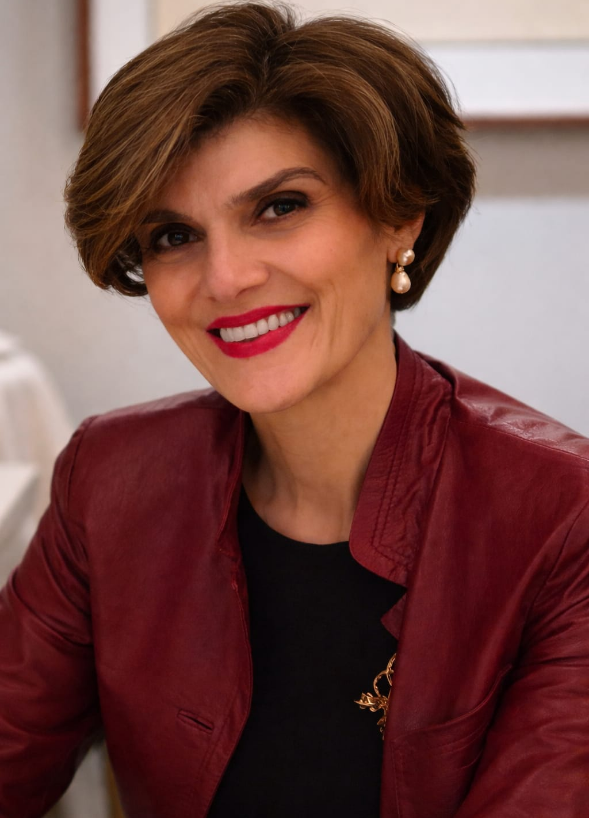
Prosthodontist Dr. Shahpari Nazeri of Sutton Place Dental Associates in midtown Manhattan has spent more than thirty years earning the kind of trust that moves people to drive from upstate New York or fly in from Boston for care they cannot find elsewhere.
In this Ailm Atelier™ interview, Dr. Nazeri speaks about the standard of excellence that drew her to the field, the integrity that defines her practice, and what it truly means to give someone back their smile.
Interviewer:
What drew you to prosthodontics, and how did that foundation shape the way you think about restoration?


Dr. Nazeri:
As a third-year student, I watched prosthodontists work and knew immediately this was the path I wanted to pursue. The way they read a case before touching it, the intentionality they brought to every decision, the quality they refused to negotiate away. That impression never left me.
I remember walking into the postgraduate clinic at NYU, seeing them in their blue jackets, and thinking about who I wanted to become. So I spoke to my teachers, went deeper into the specialty, and eventually applied to the prosthodontics program. My residency at the VA Hospital in Brooklyn came first, and it was an education in its own right. Mostly older gentlemen, complex removable prosthodontics, and a young dentist learning quickly that trust is earned one appointment at a time. Then, for two years in the NYU program, I was trained by some of the finest clinicians in New York.
More than clinical skill, this training gave me a way of seeing cases, of looking at the whole person before considering a single tooth. You aim for perfection, knowing it does not exist, but the discipline of aiming changes everything about how you work.
Interviewer:
When a patient sits down with you, how do you get to the heart of what they actually need?
Dr. Nazeri:
The moment a patient walks through the door, I want them to feel that something here is different. Not because we have engineered it that way, but because the energy in this office is genuine. My staff knows our patients by name and remembers what was shared at the last visit. That continuity is not a system. It is simply what happens when people actually care.
Most importantly, I listen before I recommend. I share what I see on the exam and on the X-ray, and I offer a plan, but I do not push. Many of my patients drive more than an hour to see me, even though there are capable dentists much closer to their homes. When I ask why they make that trip, the answer is almost always the same: because you know who we are. That is not something a new patient review can manufacture. It is built visit by visit, year by year.
Interviewer:
Your patients consistently describe you as honest, unhurried, and pressure-free. In a field full of options, how do you build that kind of trust?
Dr. nazeri:
What patients feel, I think, is that I take the work home with me. When something is unresolved, I do not leave it at the office. I carry it, think it through, and ask myself how to do right by this person. They sense that. And when someone looks at me and says, “We trust you,” I feel the full weight of that. It means I cannot afford to be anything less than honest.
I reset that intention every day. I am here to do the best job I can, technically and as a human being. At the end of the day, I ask myself whether I did the right thing. That is the only measure that has ever mattered to me.
I also tell patients, if you want a second opinion, get one. Or start with something small and see how you feel. If it works, we go on. If not, we part ways. Most people, when they hear that, choose to stay because they realize there is no agenda, just the work, and the trust built around it.
Interviewer:
You practice in a male-dominated specialty, and patients frequently speak about your feminine touch and the confidence it restores in them. What does that mean to you personally?
Dr. Nazeri:
When I started, there were very few women in prosthodontics. It was an unusual path to choose, but I chose it because I believed I had the eye for it. There is a quality of attention, a sharpness for detail, and a sense of empathy that I bring to this work, and I think patients feel that. It is not about gender as a rule. There are men with extraordinary artistic vision and sensitivity in this field. But for the patients who tell me my touch made a difference, I take that seriously. It means something to me.
I have a light touch physically, and I think that matters more than people realize. You do not want a patient leaving with jaw pain or tension from the appointment itself. I have had people tell me they nearly fell asleep in the chair. When someone can completely relax, the work goes better, and they come back.
Interviewer:
Can you share a patient experience that stayed with you and reinforced why this work matters?
Dr. Nazeri:
There is a gentleman who has been coming to see me for more than twenty-five years. When he first came in, his teeth needed significant work, a full mouth rehabilitation. Every tooth, upper and lower, had to be addressed. It was a comprehensive case, the kind that takes time and trust to see through from start to finish.
What stayed with me was something his daughter said. She was a teenager at the time, and she told him directly that she was embarrassed by how his teeth looked. That is a hard thing to hear as a parent. But once the work was done, both father and daughter were happy.
He told me later that he had been traveling overseas, had happened to mention me to someone, and had shown them his smile. It turned out the person already knew me. It’s a small world, and a beautiful reminder of what a restored smile carries with it.
He has been coming back for maintenance ever since. And when I look at his chart now and see where we started and where we are, that is the moment that makes everything worth it. I genuinely get excited when I can tell a patient they do not need anything. It means we did this right, together.
Interviewer:
What would you want Ailm Atelier readers to take away from your story and your approach to care?
Dr. Nazeri:
For the patients reading this: excellence and humanity are not separate things. The technical standard matters deeply. A restoration has to last, not for a year or two, but for decades. That requires precision, judgment, and a commitment to doing the work correctly rather than quickly.
But excellence without integrity is just a procedure. What I hope people take away is that the right provider will never push you toward a decision you are not ready to make. They will give you the information, present your options honestly, and let you lead. And when that relationship is built on genuine care, the results reflect it. You get a smile that looks like you, only the best version of you.
Contact Info